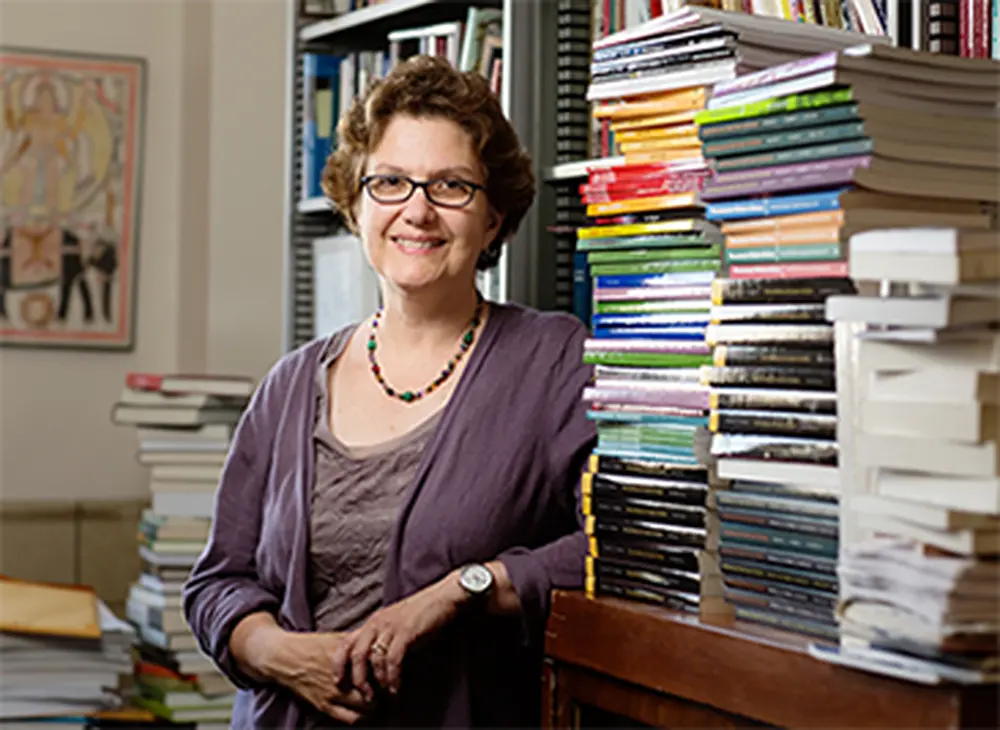
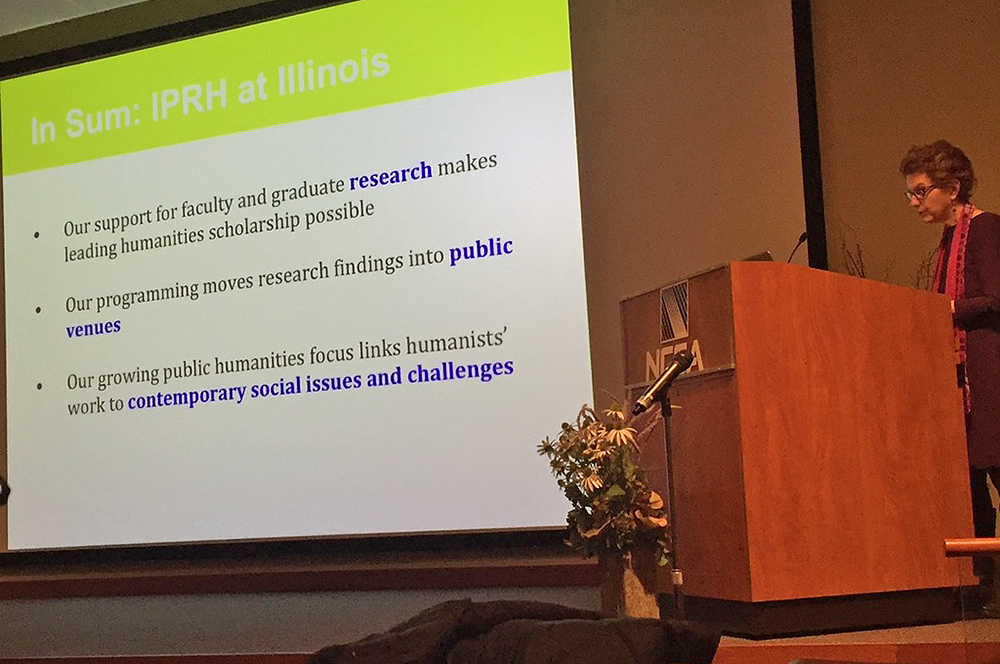
What role can the humanities play in science, education, engineering, and mathematics—and vice versa? It can be a significant one, said Antoinette Burton, director of the Illinois Program for the Humanities (IPRH) and professor of history and gender and women’s studies at U of I, during a recent talk at the National Center for Supercomputing Applications (NCSA).
Burton was a featured speaker at the NCSA Colloquia Series, where she called for integration and collaboration between humanistic and STEM-oriented units on campus.
“We are very, very invested in participating in collaborative partnerships that are driven by shared commitments to our original research shaped by humanities methods as well as interdisciplinary ones,” Burton said.
She said that U of I researchers should be engaged in providing critical interdisciplinary perspectives on science, technology, engineering, and mathematics (STEM) fields, where instead of being considered separate from the humanities, STEM would be regarded as an integral part of the cultural past, present, and future.
“For a start, I think it would be great to field (a) team of ethnographers to work every day in the NCSA building, acting as participant observers investigating the culture of big tech and big data, pushing out analyses at algorithmically significant and even insignificant rates,” Burton said.
Burton also spoke about the potential improvement of humanities research if it focused more attention on the STEM fields. For example, there are literature scholars on campus that, according to Burton, “are interested in mining the data for HathiTrust,” a digital library seeking to digitize millions of books, serials, and other forms of information and making them widely available through the HathiTrust Digital Library.
Along these lines, IPRH and NCSA have already collaborated extensively. IPRH and the Coordinated Science Laboratory are planning a conference in November 2017 called “Speculative Futures,” and NCSA is joining in to help bring attention to the fusion of creative work and big tech on campus. The event will bring together young artists, give them a tour of the technology on campus, and then talk about how said technology could be accurately integrated into their creative works.
Donna Cox, director of NCSA’s Culture and Society (C&S) Theme and the Advanced Visualization Laboratory, and a professor in the School of Art and Design at Illinois, said NCSA has had strong connections with campus humanities for a long time.
“Historically for more than a decade, NCSA has provided a home for the Institute for Computing in the Humanities, Arts, and Social Sciences (ICHASS) and for the Institue for Emerging Digital Research and Education in the Arts Media (eDream),” Cox said.
Be it digital analysts in English classrooms or poets residing in the NCSA building, Burton spoke of a more collaborative future that has the potential to broaden the academic horizons of students and researchers in all fields, in ways unimagined.