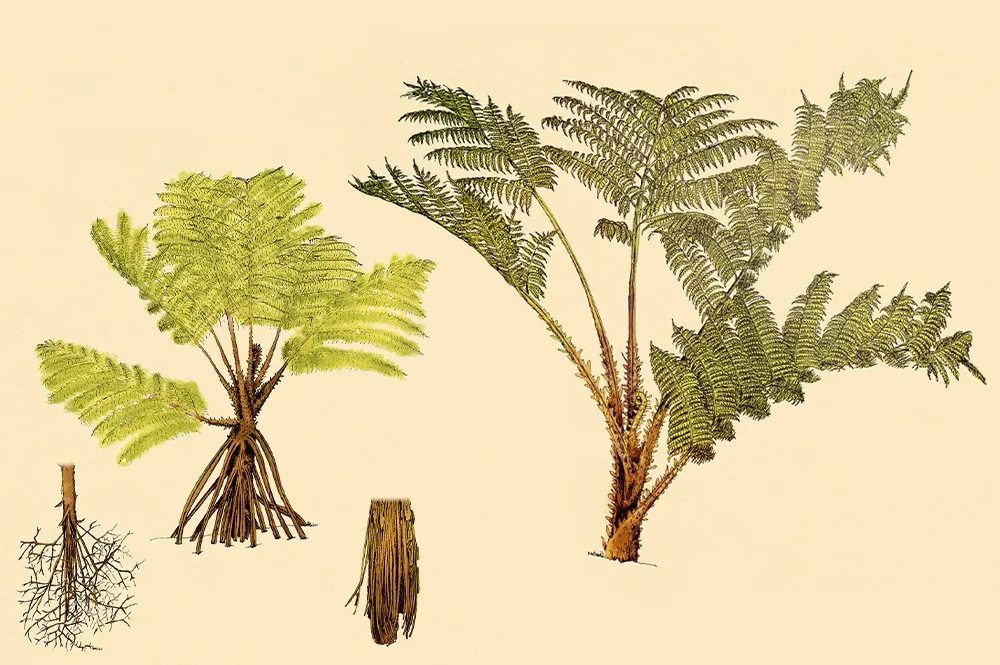
Plant biologists report that a species of tree fern found only in Panama reanimates its own dead leaf fronds, converting them into root structures that feed the mother plant. The fern, Cyathea rojasiana, reconfigures these “zombie leaves,” reversing the flow of water to draw nutrients back into the plant.
The findings are reported in the journal Ecology.
This weird phenomenon occurs only after the leaves die and droop to the ground, said plant biology professor James Dalling, who made the discovery with his team while studying a different plant in a Panamanian forest reserve. Dalling noticed that the fronds were strongly embedded in the soil and had sprouted a network of rootlets. Laboratory tests revealed that the zombie leaves were drawing nitrogen out of the soil.
Even after they are converted into roots, the wilted fronds look like decayed plant matter, which is probably why generations of plant biologists failed to notice that they were performing a life-sustaining task, Dalling said.
“This is a truly novel repurposing of tissue. And it’s distinct from what we know other ferns do,” he said.
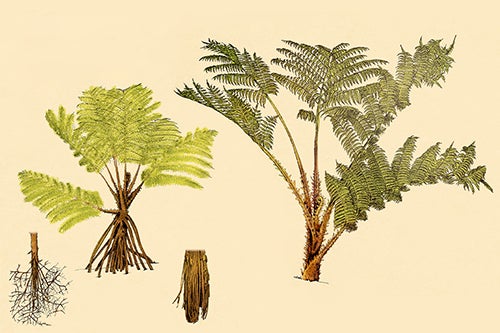
Other plants, including some ferns, send out leaves or shoots that touch the ground and sprout roots to sustain a new plant, he said. But reconfiguring dead tissue to feed the original plant has never been reported. The new findings are detailed in the journal Ecology.
C. rojasiana belongs to an ancient lineage of tree ferns dating back to the Jurassic period, Dalling said. The zombie leaves are most likely an adaptation to the nutrient-poor volcanic soils.
“Panama is a land bridge between North and South America that coalesced 7 million years ago out of an archipelago of islands, and those islands are the result of volcanic activity in the past,” he said. “In one site we discovered, a layer of volcanic ash several meters deep looks like sand that you would dig up on a sandy beach. The plants that grow there are distinct from those that we find elsewhere in that forest reserve.”
The patchiness of the vegetation means soil nutrients also are unevenly distributed.
“And so the tree ferns seem to be putting out tentacles to sample the surrounding soils,” Dalling said. “They’re able to sample a greater range of nutrient environments for the same amount of investment of rootlets than if they just sent out a single rooting structure all around the fern. I think it’s all about the economics of how they use resources in a patchy environment.”
The tree ferns also grow very slowly.
“They’re probably putting on one or two leaves a year, and so they’re adding on the order of a few centimeters of height a year,” Dalling said.
This means each frond is a major investment of resources that the plant repurposes after the leaf dies. The slow growth also means that the tree fern is short enough that when its fronds die, they droop all the way to the ground. The trees reach a maximum height of about two meters, Dalling said.
The finding is “another example of the extraordinary diversity of plant adaptations that exist in resource-poor environments,” he said.
Dalling also is a research associate at the Smithsonian Tropical Research Institute in Panama.
Editor's note: Watch a video of Dalling describing the research here.